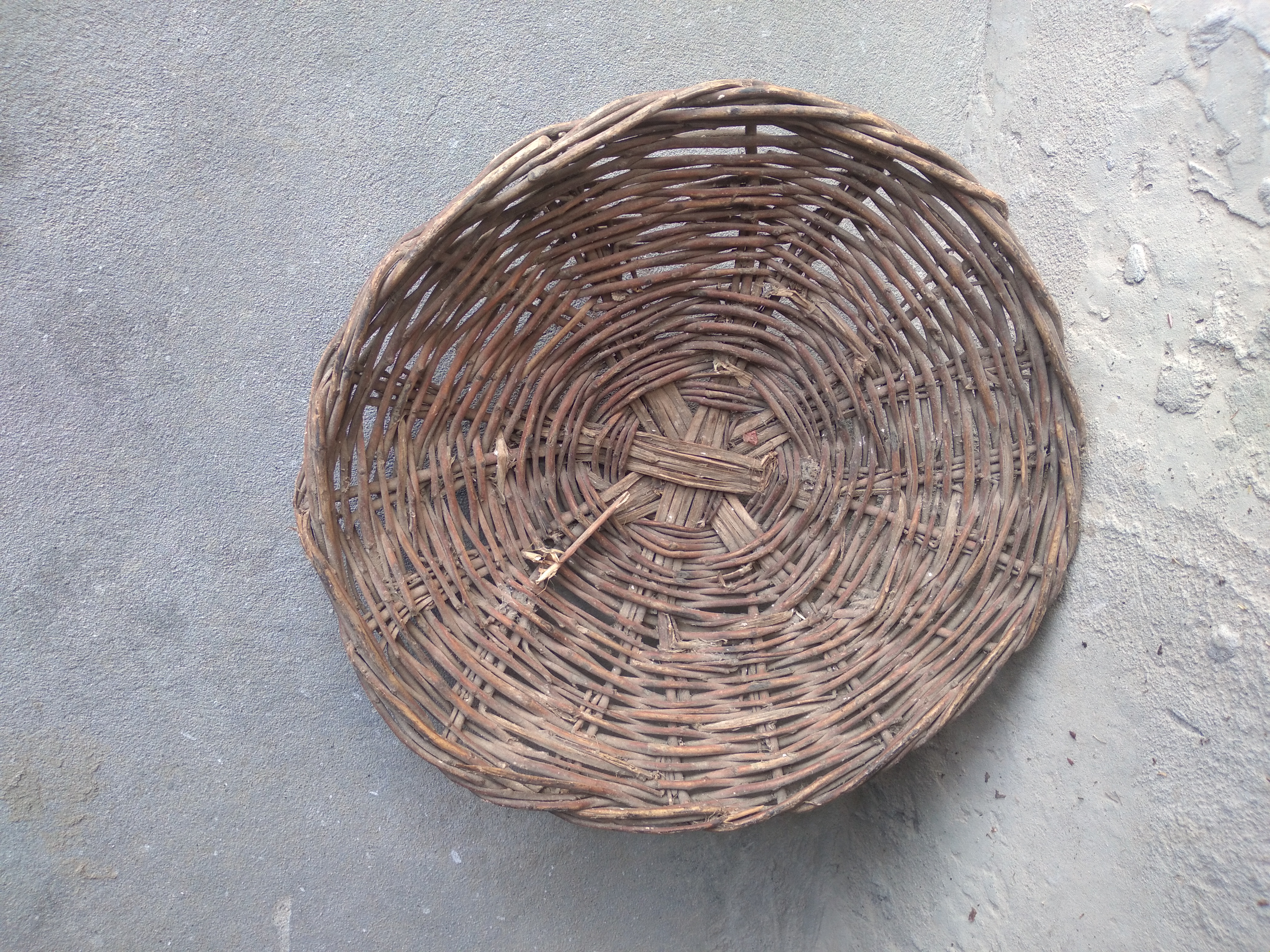
In a nineteenth-century Polish rural household, baskets were present in nearly every part of the homestead — but not interchangeably. The assignment of specific basket types to specific locations reflected practical knowledge about materials, humidity, and the properties of the goods being stored. A coiled straw basket placed in a damp cellar would deteriorate quickly; a loosely woven willow carrier placed in a dry pantry for grain storage would lose its contents through the gaps.
The Kitchen
The kitchen was home to the smallest and most varied collection of baskets. Shallow round trays and small oval carriers appeared on shelves and work surfaces for bread, eggs, and fresh vegetables. These were typically the finest examples of household basketry — made with closer weaves and sometimes decorated with additional wrapping on the rim and handles.
Bread baskets in kitchen use tended toward the straw-coiled form in Lesser Poland, where the insulating quality of coiled straw helped maintain the crust of freshly baked loaves. In Mazovian kitchens, open willow trays were more common for the same purpose, providing airflow rather than insulation.
Small willow baskets were also used for sorting and storing dried herbs, onions, and garlic — hung from beams or placed on high shelves. The open weave of these forms allowed sufficient air circulation to prevent mould without the contents drying out completely.
The Pantry
The pantry (spiżarnia) required baskets suited to longer-term dry storage. Tall cylindrical containers with fitted lids were used for flour, dried legumes, and preserved foods. In households with access to rush-woven containers, these appeared in the pantry for herb storage — the soft, absorbent rush material was considered unsuitable for wet or heavy contents but appropriate for lighter dry goods where some residual fragrance was acceptable.
Rectangular chests in the pantry stored textile goods, dried seeds, and items that needed to be kept together but accessed occasionally. Documentary records from the Muzeum Krakowa collections note examples of pantry baskets that were sealed with cloth stoppers or beeswax-coated lids, suggesting that keeping air out was sometimes as important as letting it in.
The Cellar
The cellar (piwnica) presented the most demanding conditions for basket storage — cool temperatures, elevated humidity, and contact with earthen floors or walls. Willow baskets were used here for storing root vegetables, but the construction was specifically adapted for the conditions: heavier stakes, denser base weave, and no straw wrapping on the rim that could absorb moisture and rot.
In Kurpie and some parts of Podlasie, pine root baskets were preferred for cellar placement precisely because of their greater moisture resistance. Birch bark containers, where available, were also used for dry cellar goods — their waxy surface provided more resistance to ambient humidity than plain willow.
Storage practice note: Root vegetables stored in baskets in the cellar were typically placed off the earthen floor on wooden slats or raised wooden platforms. The basket's breathable walls were the primary advantage over sealed wooden boxes — they allowed the slow gas exchange needed to prevent premature sprouting.
The Barn and Agricultural Buildings
Agricultural baskets were larger, coarser, and subject to harder use than household forms. Oval field carriers — the most commonly documented agricultural basket type — were used to move harvested crops, animal feed, and other bulk materials. These baskets were not expected to last decades; ethnographic accounts suggest seasonal replacement of the most heavily used field forms was normal.
Grain winnowing required shallow, wide-rimmed trays that could be tilted and shaken. These tended to be made with a relatively loose but even weave, so the chaff could escape while the grain was retained. Different regions used slightly different proportions for these forms based on the specific crops grown — wider and flatter for grain, higher-walled for smaller seeds like millet or poppy.
Transport Uses
Market travel — carrying produce to town — required baskets that balanced capacity, weight, and durability. The backpack-style pannier (plecak wiklinowy in some regional vocabularies) was woven with shoulder loops rather than side handles, allowing a single person to carry a larger load. These forms appeared in areas where long-distance market travel by foot was common, particularly in mountain foothills regions of Lesser Poland.
Birch bark cone baskets were specifically associated with berry and mushroom picking — lightweight forms that could be carried during a long walk through the forest and filled gradually. Their waxy surface resisted staining from berry juice, and the shallow shape prevented the contents from being crushed under their own weight.
Storage Location Summary
| Location | Basket Types Used | Primary Contents | Key Material Requirement |
|---|---|---|---|
| Kitchen | Shallow trays, small carriers | Bread, eggs, herbs, vegetables | Fine weave, clean surface |
| Pantry | Tall cylinders, rectangular chests | Flour, dried goods, textiles | Close weave, fitted lid |
| Cellar | Heavy willow carriers, pine root | Root vegetables, preserves | Moisture-resistant material |
| Barn | Large oval carriers, trays | Grain, animal feed, harvest | Durability, open weave |
| Transport | Panniers, birch bark cones | Produce, berries, mushrooms | Lightweight, portable |
Baskets as Household Infrastructure
What the documentation from ethnographic collections makes clear is that baskets in the rural Polish household were not decorative objects or secondary storage solutions — they were primary infrastructure. The range of forms present in a well-equipped household corresponded directly to the range of storage tasks the household needed to perform across the seasons. The assignment of specific forms to specific locations was part of practical household knowledge, transmitted through observation and use rather than written instruction.
Collections at the Państwowe Muzeum Etnograficzne w Warszawie and regional museums in Kraków and Łódź hold documented examples of household basket sets, sometimes including inventory records that list the baskets present in specific rooms of documented farmhouses.